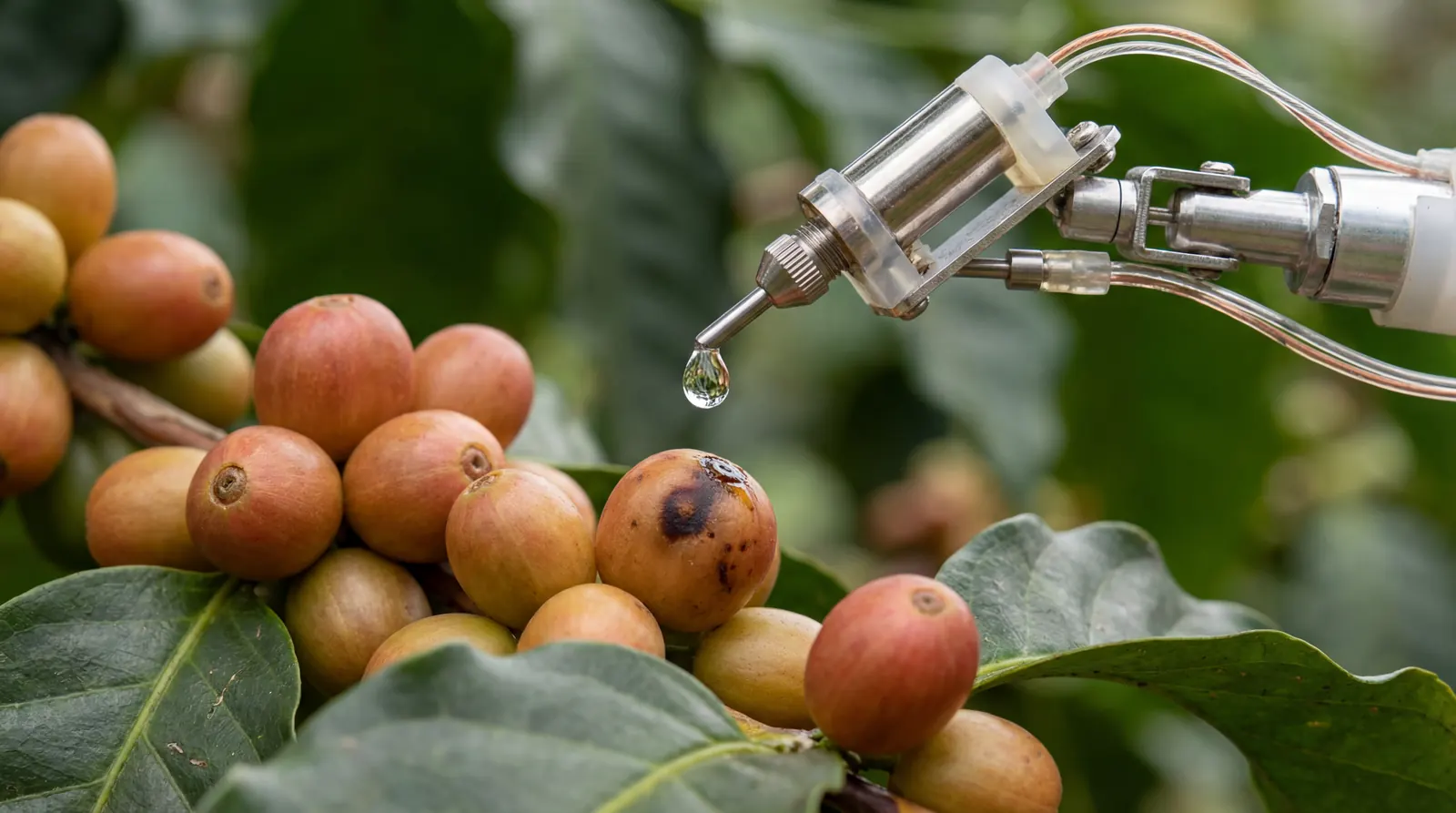
AgroMind is a vertically-integrated robotics stack: insect-scale hardware operating inside the canopy, on-device perception, swarm coordination, a live digital twin, and a cloud layer that learns across plots and seasons.
Every robot runs the full loop on-device. The fleet coordinates as a swarm. The cloud trains the next generation of models on what the fleet learns.
Macro-resolution cameras, environmental sensors and proximity awareness, captured from positions no aerial or ground tool can reach. Continuous streams, not snapshots.
Edge inference for real-time decisions inside the canopy. Cloud training pipelines for new pests, diseases and crops. A digital twin keeps every plot in sync.
Precise micro-dosing at the infection site, followed by a verification scan to confirm suppression. The action closes the loop the rest of the field can't see.
Each layer is built to work with the others — not as a marketplace of point tools, but as a single robotics platform engineered around one problem.
Insect-scale robot built for canopy operation. Designed for accessibly-priced serial production, with a payload tuned for micro-dosing and on-board perception.
On-device inference for detection, decision and treatment verification. Runs without permanent cloud connection, so the system works deep inside the canopy and far from connectivity.
Coordinates multiple robots inside the same plot — task allocation, area coverage, redundancy and shared situational awareness. Built for graceful degradation when units drop or reposition.
The runtime layer the swarm runs on. Mission management, telemetry, secure update channels, and an API surface for integrations with downstream systems.
A live, plant-level model of the plot. Risk zones, treatment history, microclimate, and disease progression all flow into one structure that decisions and reports read from.
Model training, fleet management, cross-plot analytics and external integrations. The cloud doesn't make field decisions in real time — but it's where the system learns.
The hard problem isn't building a camera, a robot, or a model — it's making all three operate reliably inside a real canopy, at a unit cost that growers can absorb, with treatment outcomes that hold up across seasons. Our patent strategy is in development across four areas:
Patents pending across the four areas above.
The MVP is intentionally narrow. The goal isn't the full platform — it's a closed-loop demonstration on a single pest, in a controlled plot, with technology choices we can scale from.
A small, controlled swarm operating in a real coffee plot — enough to validate coordination, treatment and verification end-to-end.
Initial models trained on one of the three coffee use cases. Detection-first, then treatment, then closed-loop verification.
Standard, open robotics middleware for the runtime. A minimal grower dashboard to make the system legible from day one.
A field-deployable compute, comms and charging anchor. The smallest viable unit that lets a swarm run continuously in a plot.
If any of these feel like the problem you want to spend the next few years on, we'd like to talk.
How does a small robot move inside dense, irregular foliage — finding stable footholds on branches, navigating across leaves, and operating reliably across coffee, vine and orchard canopies?
How do we identify diseases and pests before they're visually obvious — using vision, spectral signals, and environmental context, with limited initial training data and high false-negative cost?
Precise on-target delivery of active material at the leaf or cluster level, followed by an in-situ verification scan that closes the treatment loop. Mechanical, fluidics, and perception all interact here.
Coordinating a small swarm inside a plot with intermittent connectivity, partial information, and units that may drop or reposition. Graceful degradation matters more than raw performance.
Form factor, materials, manufacturing and service model all combine into the question that determines whether this scales: can a grower afford to deploy this — and what does the cost curve look like at volume?
Once the first robots are operating in-field, we'll publish the API surface, integration guides, and the parts of the stack that make sense to open up. If you'd like early access — or to influence what gets opened — get in touch.